Drawstring Mini and Bucket Bags: What to Check in Photos
A grounded checklist for drawstring mini and bucket-style bags, using album examples with soft structure, small dimensions, gathered tops, charms, and shoulder or crossbody carry.
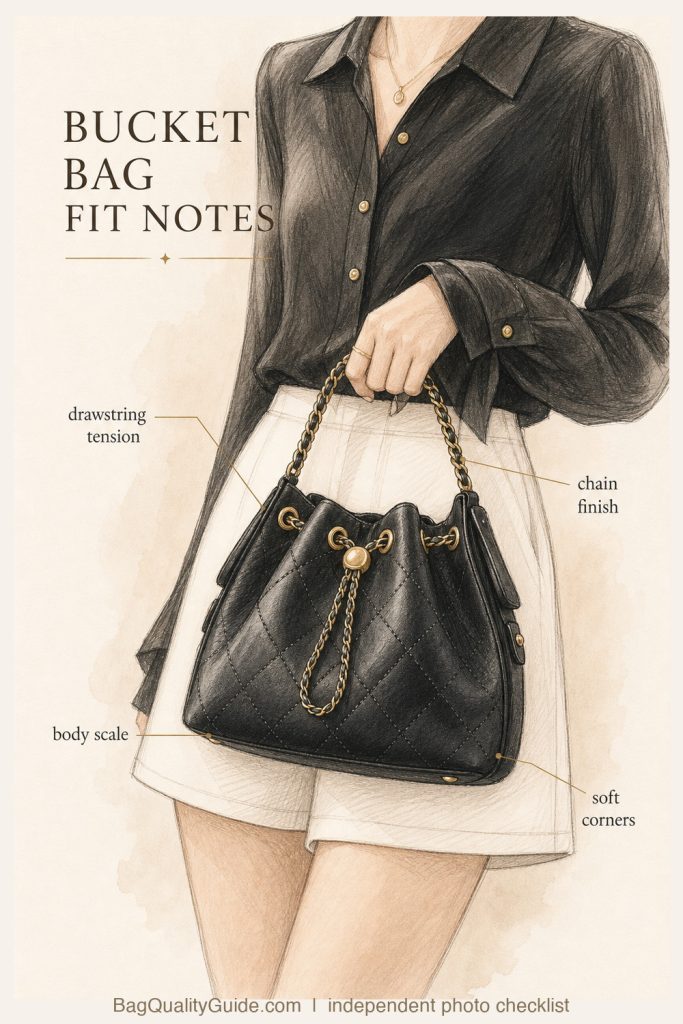
A drawstring mini can look charming in styled photos, but it needs a very practical review. The sampled album included a small drawstring style around 12 x 18 x 5 cm, with a soft body, gathered top, decorative details, and shoulder or crossbody use.
That kind of bag succeeds only if the closure, opening, strap, and body shape work together.
What the sampled albums showed
The drawstring mini example was small enough that capacity and opening width matter immediately. It also used soft material language, which means a buyer should inspect drape and structure instead of only looking at front beauty photos.
The second album also had bucket, hobo, and soft carry categories. Those shapes all need photos that show how the bag behaves when worn or closed.
What to inspect in similar listings
Open and closed top
A drawstring bag should be judged in both states.
- Ask for the top fully open.
- Ask for the top fully closed.
- Check whether the gathers are even.
- Look for strain where the drawstring exits the channel.
Base and side seams
Small soft bags can twist easily.
- Ask for a side view.
- Check whether the base sits flat or leans.
- Look at side seams for twisting.
- Check whether daily items change the body shape too much.
Carry style
A small bag may be wearable in more than one way, but strap length decides comfort.
- Ask whether it can be shoulder, crossbody, or handheld.
- Check strap attachment points.
- Look for pulling at the top when the strap carries weight.
- Confirm whether decorative hardware interferes with the closure.
Questions worth asking before you decide
- Can I see the drawstring open and closed?
- Can I see the base and side seams?
- Can I see the bag with small daily items nearby?
- Can I see how it hangs from the strap?
Drawstring and Bucket Bag Photo FAQ
What photos should I ask for on a drawstring or bucket bag?
Ask for the top fully open, the top fully closed, a straight front and back view, both side profiles, the base, the interior opening, drawstring channel exits, strap attachment points, and a worn-scale or daily-items photo. These photos make it easier to judge closure behavior, capacity, structure, and strap balance.
How do I check whether a bucket bag keeps its shape in seller photos?
Compare the bag empty and gently filled if possible. The base should sit reasonably flat, side seams should not twist, the gathered top should look even, and the body should not collapse in a way that hides the opening. If the album only shows a styled front photo, ask for side, base, and open-top views before deciding.
Which missing angles are red flags for a drawstring mini bag?
Be cautious when a seller skips the fully open top, fully closed top, base, side seams, drawstring channel exits, strap anchors, or interior depth. Those missing angles make it harder to judge usable space, closure strain, body symmetry, and whether the strap pulls the soft structure out of shape.
Editorial note
The album samples were used as research inputs for bag shape, size, material, hardware, and photo-review patterns. Bag Quality Guide does not publish third-party album photos here and does not make official brand or authenticity claims.
Have an Expert Review Your Bag Photos
Send the photos or album. We’ll point out visible quality red flags, missing angles, and the extra photos to ask for before deciding.